
In this offering, grief moves through two channels—my studio and my community. Painting becomes a way to hold what feels unbearable, and climate grief rises into view through the voices of young people who refuse to look away.
(If you’re new to Eclosion: An Artist’s Path to Power and Peace, start at the beginning. Or visit my Memoir Hub for a full table of contents with links.)
Grief in Color
“Mama’s tears tasted like sea water.”
Vermillion by The Waifs
Music has always been a core component of my experience—of my identity. I remember lying in bed as a child, Guns and Roses flowing through the floor vent from my older sister’s room as she played “Sweet Child O’ Mine” over and over again. My brother listened to death metal, giving me my first recording of DR—full of inappropriate lyrics I can still recite by heart. In high school, in the late ‘90s, in Bismarck, North Dakota, a friend introduced me to the music coming out of Olympia, Washington. Through the Riot Grrrl movement, I discovered music that changed my life: Heavens to Betsy, Sleater Kinney, Bikini Kill, Bratmobile, and so many others. They fueled my early transformation, exploring feminism, racism, and social change through righteous anger.
In sobriety, I had to let go of much of my righteous anger—as a recovering alcoholic, stewing in anger, righteous or not, is a dangerous place for me to be.
Now though, I was deep in grief. One of the places I took this grief was to my studio, where I scheduled three evenings a week to paint, after Seren went to bed.
This studio time looked different than it ever had before. In recent years, most of my paintings were uplifting, transformative in the realm of claiming and reclaiming the power of the divine feminine. It had been a long time since I painted myself ripping my heart open with the pain of vulnerability.
Over the previous couple of years, I discovered so much amazing music—music that was transformative and positive, that I could groove to while I painted. I began incorporating music into my studio time in an entirely new way. In each session I dropped into my body through drumming and singing. I sang a few songs ritualistically, including “Into the Wild” by Shylah Ray Sunshine and “We Rise” by Batya Levine. They were anthems to claim my power, to transform our world. They were words I needed to hear, and more so, words I needed to say.
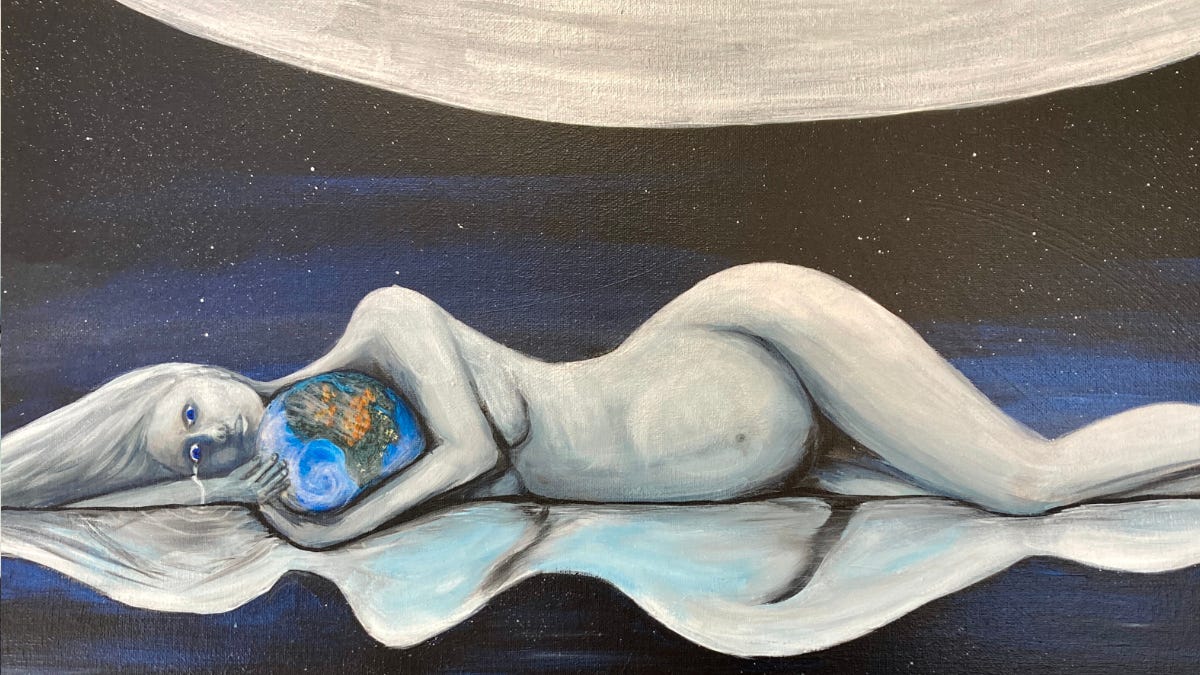
To this day, “Into the Wild” is a favorite song for me and Seren to sing together. I would drum. I would sing. After a while, I would paint. In my grief, my entire color palette shifted—from warm to cool, from light to dark.
The new painting series I was working on came to me while on a run. I literally ran back to my studio, images of the earth crying, and the seas rising flickering through me. My pencil flew across the paper as I started to sketch. The Universe gifted me a creative outlet to cope with my fear and grief. The series is called Sea Level Rise: The Mother’s Tears. In it, a woman—the Earth, the Mountains, the Sea, the Mother—lies weeping on the horizon. Her tears enter the sea, causing it to rise and drown her sorrows. This is her grief, her fear, her healing, her love. The earth is on fire, and she drowns the flames in her tears.
When working on these paintings, alone in my studio at night, I somehow transcended the fear and overwhelm that were my constant those days. I was lifted out of my worries. At the same time, the creative process allowed me to move through emotions brought on not only by the crisis my family was facing, but the global climate crisis.
The grief I was painting didn’t belong to me alone. It was of fire, of floods—of a world unraveling before my eyes. The act of painting kept me present, moving me forward one brushstroke at a time.
Climate Grief
As I painted my grief at home, I was still working with the Thurston Climate Action Team. TCAT was where the Chrysalis Project began, and I was their Lead Artist and Community Engagement Expert—often working with young people, supporting their climate clubs and actions.
The Thurston Youth Climate Coalition reached out that spring, asking for support for their upcoming protest. They needed paint and brushes to make signs, something I could easily provide. I’d worked with most of them before, a few during the Chrysalis Project. I was continually impressed with the creative actions they were taking for the climate—actions with specific and doable steps for our community and local governments.
After dropping off the art supplies, I interviewed the students about their work as climate activists to help promote their upcoming action. I’ll never forget our conversation. One activist shared that adults often told her how much she inspired them. Her response: “We aren’t doing this to be cute or inspiring. We are doing it because we don’t feel we have any other options. We are genuinely terrified about this.”
Another talked about the mental health crisis that climate change was causing.[1] “When I learned about the climate crisis, I was suicidal for months. Having community and taking action together is the best way to come to terms with the climate crisis. To acknowledge the problem and do something about it.” What she was describing—climate grief—was heartbreakingly familiar.[2] I’d heard versions of it from other young people, too.
Still another showed how much they already knew about the problem. “Getting involved in climate action can get you out of your bubble. Then you’re exposed to the fact that there are solutions that we can implement now. We have the technology. We have the money. What we lack is the political will. We are here to push our elected officials to have that courage.”
Creating art collaboratively is one of the biggest gifts the universe has given me. I love facilitating groups through the creative process, from design conception to art installation. But what keeps me coming back is the transformation. It’s the aha moment. The light in someone’s eyes when they get it. Seeing others take that light into their own hands and share it is extraordinary. I couldn’t help but be inspired by those students, even knowing that’s not what they wanted—all they needed from me was some paint. They had the rest of it. My heart warmed with pride seeing them use creativity in a way that supported their own well-being while showing the rest of us what courage and community looks like.
Stepping into my studio to paint Sea Level Rise: The Mother’s Tears was a much more solitary experience—one that required an entirely different type of vulnerability. I was trying to do something with paint that I hadn’t done before, and it took many attempts before I painted the one painting where my vision fully came to life. I kept returning again and again to following my curiosity.
What if I put this brush stroke here? How about if I add leaf stamps in this way? This work was incredibly personal, and my old fears would sometimes creep in. It’s just me after all, with my paints, brushes, and canvases. And music, of course, always music. Sometimes, though, like when I received the ideas for this painting series, I know I’m not alone, and that is pure magic.
[1] According to the American Psychological Association, two-thirds of young people today are experiencing climate grief. https://www.apa.org/monitor/2021/03/ce-climate-change
[2] Climate grief is the emotional response to the loss and anticipated loss of ecosystems, cultural practices, identities, and landscapes due to environmental changes and degradation. https://www.climateandmind.org/what-is-climate-grief
Where do you put your grief—so it can move, instead of staying trapped?