
Treatment was wearing on us both. As Shon cycled in and out of being present, I cycled in and out of roles—caretaker, decision-maker, partner—trying to hold it all without losing myself.
(If you’re new to Eclosion: An Artist’s Path to Power and Peace, start at the beginning. Or visit my Memoir Hub for a full table of contents with links.)
Balancing Act
In many ways Shon was easy to care for, rarely complaining about his situation. Even so, the cycle of his treatments was wearing on us. Now that he was receiving treatment in Olympia, travelling to and from treatments was an easy five-minute drive. But the addition of chemotherapy, while continuing to receive immunotherapy, was hard on Shon’s body. Every four weeks he would spend two full days at the hospital, drowsy and sleeping while the life-saving poison, coupled with large doses of antihistamine and steroids, dripped into his veins.
I’d bring him home after treatments and he would go to bed, staying there for days. When he would rouse himself to join us for a meal, he wasn’t fully there—the light gone from his normally bright eyes. He didn’t engage in conversation. He was simply existing, separate from us.
During these long days, I felt my own strength being tested. As the sole caretaker, the weight of our day-to-day life grew heavier. I juggled my roles as best I could, trying to be brave for Shon and especially Seren. Inside, I still grappled with fear and loneliness. The house felt emptier, the silence louder, and his sporadic presence a poignant reminder of the fragility of our situation.
About a week or so after each treatment, he would begin to come back to himself, and to us. We were thrilled to have him back, but there was a new tension. While he was sick and in bed, I made all the decisions for our family—Shon so out of it that he hardly noticed decisions were being made. As he came back to himself, he suddenly had opinions and wanted to be part of the decision-making. This was only natural, but this push and pull of roles added a layer of complexity to our already-strained interactions. At times, I felt relieved to share the burden; at others, I was irritable, not wanting to take the energy to remake decisions and plans with him when I knew that soon he would be out of it again and everything would fall back on me.
Navigating this ever-changing landscape was a difficult dance. Once I realized how this cycle kept playing out, the back and forth of the dance came easier—I learned to make space for him as he felt better, then stepped back in to lead when my strength was needed. This part of our journey, though wrought with challenges, was also a place where we grew together.
I was proud of how I was learning to show up for my family during this difficult journey, holding steady even under immense pressure. But the human body, like scaffolding under strain, can only hold so much.
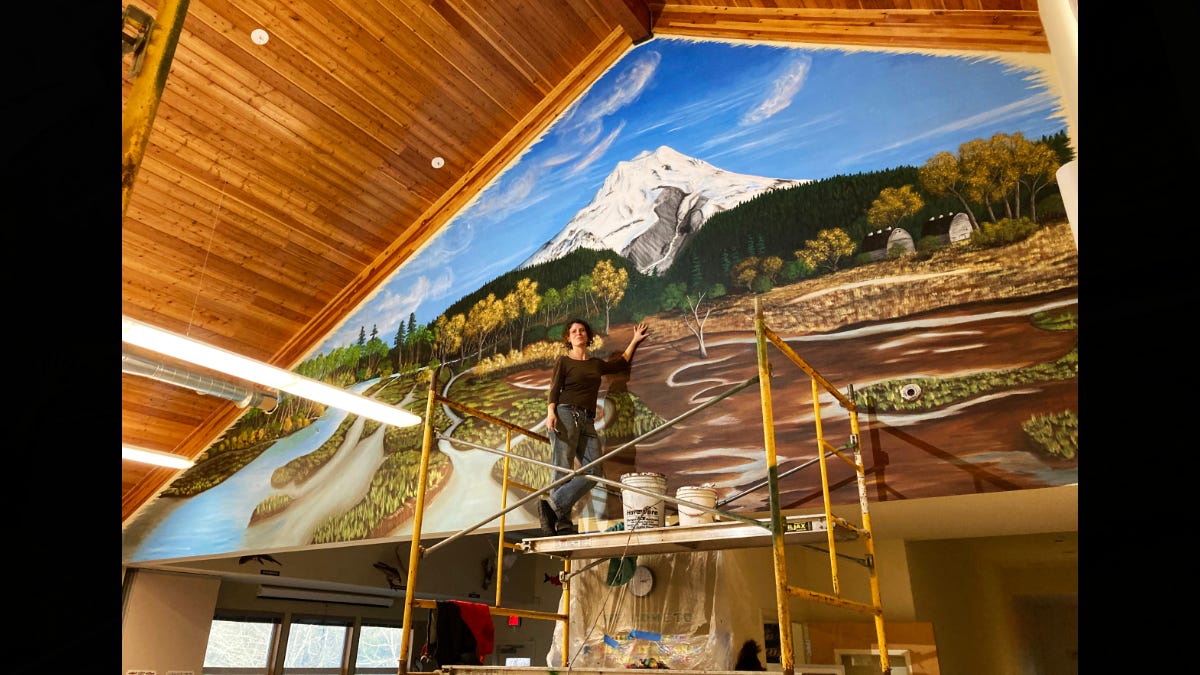
As a mural artist, I often work from tall scaffolding. Fortunately, I am used to heights. When I was in my late teens, I worked for my dad, building houses. We did most everything from framing to finishing and “safety equipment” was not part of my dad’s vocabulary. I clearly remember my dad walking across the tops of 4-inch-wide walls on the daily, carrying heavy tools and placing rafters. He was fearless and graceful. My father’s seeming fearlessness taught me to push through my own fears, though I often wondered how he carried that weight day after day. Looking back, I think about how much strength it takes to balance on those narrow beams—just as I had to find my own balance through Shon’s cancer journey.
I remember how one day, while working with my dad, I needed to get from where I was on my ladder to another part of the open roof. Instead of climbing down and moving the ladder to the other spot, which is what I would normally do, I stepped onto the four-inch-wide wall and walked twelve feet across to the other side, so afraid I would fall, but doing it anyways.
“Look dad!” I called. “No hands!” He did look, he gave me quite a look in fact, asking what the heck I thought I was doing, much more concerned for my well-being than his own.
Sometimes, when mural painting, I need to get to high areas 30 feet or more above the ground. Working at those heights is exhausting in itself. One wrong step could mean a fall, so I must constantly have part of my attention on where my feet are. Assembling the scaffolding is fatiguing on an entirely different level. Each level we add gets shakier and so much farther from the ground. Falling would mean serious injury or death. To keep my balance and get the scaffolding secured so that I can do my work, I enter a type of forced meditation: I don’t allow myself to think of falling—or anything really—other than the next step required to put the scaffolding together. This mental focus gets the job done, and I’ve never fallen, but it wears me out in a way that is unlike any other manual labor I do.
In much the same way, the scaffolding of my life during Shon’s cancer journey grew taller and shakier with every added stressor—doctor appointments, caregiving, and the endless unknowns. Every step forward required careful calculation and an unrelenting focus to avoid a fall. Instead of a 30-minute process, I constructed that scaffolding for months on end. Throughout that time, I kept my gaze fixed straight ahead, never veering left or right, focusing solely on the next immediate step. I couldn’t allow myself one misstep. If I did, I would fall, and I might not be able to get up again.
To stay sane, I kept myself rigid.
Looking straight ahead got me through but was exhausting. While physical falls from scaffolding can leave visible scars, the emotional scaffolding of holding it together for Shon left invisible ones—scars that manifested in chronic neck pain and daily headaches. I did all the things I knew to do, both self-care and physical therapy, but the pain persisted. Stress leaving its mark once again.
Where in your life are you holding more than your share—and what might it look like to find balance?