
What began as one workshop became a movement. I’m still learning from what unfolded—and from the people who helped shape it.
(If you’re new to Eclosion: An Artist’s Path to Power and Peace, start at the beginning. Or visit my Memoir Hub for a full table of contents with links.)
Art as a Tool for Community-wide Change
“I’ve got to believe I’m here
to make a difference without fear
of being seen or heard.”
~Into the Wild by Shylah Ray Sunshine
One week before we went into lock-down for the Covid-19 pandemic, I began working for the Thurston Climate Action Team (TCAT). I took the job as a way to connect more deeply with climate action work in my local community. Notably, I was not hired as an artist—I was hired for my organizational skills. We even talked about this in my interview, since we’d had some artful collaborations in the past. I assured TCAT that I could do the job without turning it all into a big art project. How wrong I was.
When we went into lock-down, TCAT, along with so many others, scrambled to re-envision all our work and move it online. We decided to begin with a series of online workshops, each focused on a different climate topic. I hesitantly offered to do a workshop on the Power of Collaborative Art, keeping in mind that we all knew that art was not what I’d been hired to do. They agreed and so I began planning the workshop.
As often happens, this single workshop began to grow and evolve in my mind, transforming into something much larger. It took on a life of its own as it morphed into a full-scale virtual Art in Action Campaign.
At the time, our local jurisdictions of Thurston County, Olympia, Tumwater, and Lacey were in the process of writing a climate mitigation plan. TCAT was leading the public effort to ensure it was a strong plan that would meet steep targets.
I knew that the Art in Action Campaign spinning in my head and heart had the potential to pull the words of the plan off the page—where plans often get stuck—and translate them into action. There I was, with this fantastic idea for how to make our work impactful, and it was by doing the exact thing I said I wouldn’t do in my interview. Knowing rejection might be what I’d get, I pitched my idea to my team at TCAT, sweaty hands and all. And they said yes. They agreed that this Art in Action Campaign was our best option to continue our important work and make an impact during this challenging time.
As I’ve grown my collaborative art practice, it has become increasingly important for me to bring stakeholders into the design process. In addition to getting feedback from my team, I scheduled sessions with educators and youth climate activists. Together, we co-created what became The Chrysalis Project: Transforming Together.
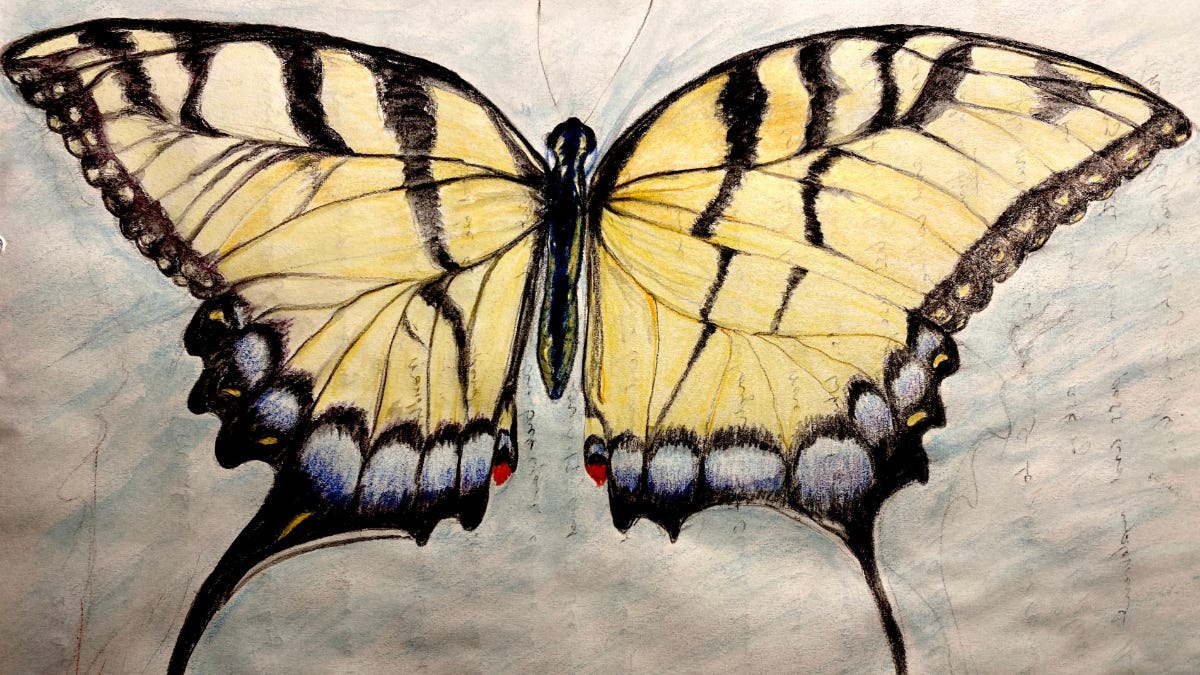
During the Art in Action Campaign, I held online workshops with over 200 youth and adults. In these workshops, we explored the power of art to create change. We examined the critical moment we were in—a triple crisis consisting of a global pandemic, a racial reckoning, and the climate crisis. We used the chrysalis—a place of transformation where a caterpillar becomes a butterfly—as a metaphor to understand the personal and societal changes we were undergoing during this pivotal time.
Together we created visions of what we wanted to be when we emerged from our individual and societal chrysalides.
When I held workshops for The Chrysalis Project, my body came alive with emotion—my throat tight and tears welled in my eyes, threatening to fall as I shared my vision. It was through this project that I began to share my belief that we really could have a different world—a world where we ALL have a chance to thrive. Saying this out loud was a giant leap into the unknown.
How dare I, with all my imperfections and uncertainties, claim that things could be different—that they could be better? How dare I profess to have, if not a plan for getting there, at least a piece of the puzzle, and a willingness to create a space for the vision to unfold?
As I stood there in front of the camera, vulnerable and trembling, I realized that daring to believe in this vision wasn’t just about me—it was about inviting others into a collective act of courage. Through collaborative art and leadership, I was creating a space where people dared to see themselves as part of something larger, as integral pieces in building this world we all longed for.
Those workshops were not only vulnerable for me. Every person who envisioned themselves within a chrysalis, dissolving into imaginal cells, and reshaping into something new. Every person who penned a letter, capturing their presence and emotions during that intense time. Every person who channeled their art to forge a vision of a future where we all could flourish. Every single one of them stepped into an act of bravery.
They allowed themselves to feel what they were feeling, to connect with others in those feelings. They expressed themselves creatively and dared to dream of a different world. They stood in their power and demanded that our elected leaders do their damned jobs and lead.
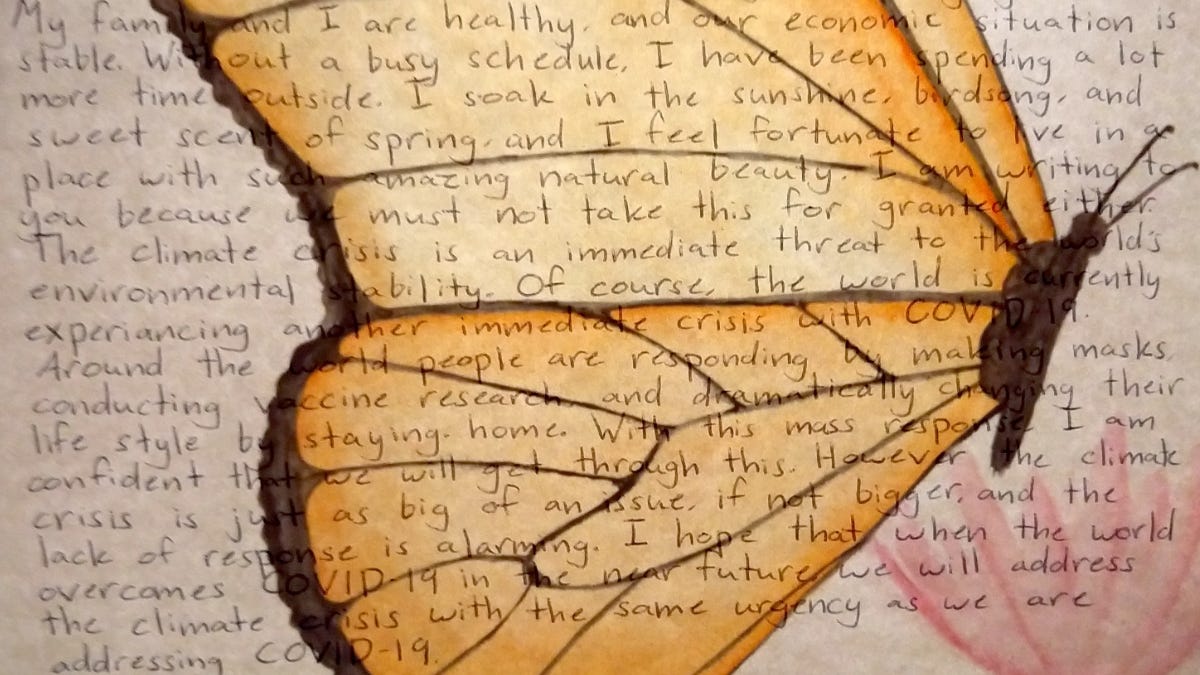
Using items from their homes, participants painted, wrote, and collaged visions of vibrant futures—not just of survival, but of thriving communities and ecosystems. They then flipped their artwork over and wrote letters to local elected officials on the back of their creations. In these letters, participants shared where they were and how they were feeling during those early days of the pandemic. They shared the actions they were already taking and pledged to deepen their commitment to climate justice.
Participants then asked, and in some cases demanded, local officials take bold climate action—to pass and implement a robust, transformative Thurston Climate Mitigation Plan. They took their letters, with the artwork on one side, folded them, put them in envelopes, addressed them, and mailed them to their city mayors, council members, and county commissioners in all four of our local jurisdictions. These were powerful calls to action with an undeniable impact on our elected officials.
In an early workshop, one adult participant photographed and emailed his letter and drawing to his commissioner. The response he received was moving: “What a very kind and uplifting note! Thank you. I’m going to print this butterfly (did you draw it?), frame it and refer to it on camera and display it in my office & on FB. Yes, climate action needs to progress along. I will do my part.”
This was an incredible response from a conservative county commissioner, underscoring the transformative power of the campaign. His commitment was the first of many potent responses from elected officials.
The Thurston Climate Mitigation Plan was finalized that fall. It was, and is, a very ambitious plan, aiming to reduce emissions 45% below 2015 levels by the year 2030, and 85% below 2015 levels by 2050. For elected officials in some jurisdictions, voting to approve this plan could have jeopardized their political careers, so it was not an easy sell. TCAT continued to advocate for passing the plan, rallying behind the ideas and visions that came from The Chrysalis Project.
In February of 2021, the Thurston County Commissioners met to vote on whether or not to pass and implement the plan. When it was County Commissioner Tye Menser’s turn to give testimony, he stood up and pulled a letter out of his pocket. He told the people gathered there that he had carried the letter around for months as his guiding light. It was a letter from The Chrysalis Project, written by a high school climate activist. He then read this letter as his testimony as to why Thurston County should adopt and implement the Thurston Climate Mitigation Plan.
That night not only did the county commissioners vote to adopt and implement the plan, they also declared a Climate Emergency for Thurston County—a resounding victory for our community. In part due to The Chrysalis Project: Transforming Together, all four of our local jurisdictions adopted the plan and three of the four declared a Climate Emergency.
The Chrysalis Project was a profound reminder of the power of art to inspire action, forge connections, and create lasting change—especially when communities come together with purpose.
This was the second time one of my Art in Action Projects directly influenced government decisions. This outcome reinforced why this work matters so deeply: It creates opportunities for people to not only see, but to experience new possibilities. Moments like these—the sudden shift of insight in the room when I work with a local government agency, the sharp intake of breath in a mentee who steps through a block and embodies the possibilities of their art—keep me moving forward. It is why, despite the knots of anxiety I sometimes feel, I push myself to speak on stages, sharing stories of collaborations and art that have sparked change in individuals and on community-wide levels.
Doing this work keeps pushing me to grow more and more. It is rarely easy, and sometimes doubts creep in. Other times, there are moments of pure synchronicity and bliss, where my path is clear as a pristine mountain stream. At those times, I know: When we face our fears and work together, we have the power to transform not just ourselves but the world around us.
What is one thing that unexpectedly changed you?